Velvet vs. Linen Sofas: Which One Actually Lasts?
Both look incredible in the showroom. Both look completely different five years in. Here's what to know before you pick a fabric you'll be sitting on for a decade.
A sofa is the most expensive piece of furniture most people ever buy, and the fabric is the part that decides whether you'll still love it in five years or be quietly resenting it by year two.
Velvet and linen are the two upholstery choices that dominate every considered-furniture buying decision right now, they're what you see in every "shoppable" Instagram living room, and they're the two fabrics nearly every mid-range brand offers as their headline option. They look nothing alike, they age nothing alike, and they cost about the same.
Most articles comparing them are written by people who've never actually lived with either fabric for more than a season. This one is written after staging hundreds of rooms with both. Here's what actually matters.
The short version
That's the whole answer. The rest is the why.
If you have pets, kids, or a household that uses the living room every day: performance velvet. (Performance velvet, specifically, not cotton velvet. The difference matters and we'll get into it.)
If you live alone or with adults, want a sofa that ages with character rather than wearing out, and can tolerate a wrinkled-but-cozy aesthetic: linen.
If you're on a tight budget and need it to last: linen. Lower-grade velvets crush and shed faster than even cheap linen.
That's the whole answer. The rest is the why.
How they actually wear
The cotton velvet sofa is mostly a high-end specialty item these days.
There's an industry metric called the Martindale rub count, it measures how many cycles a fabric can withstand before showing visible wear. Higher is better. The rough numbers:
- Cotton velvet: 15,000–20,000 rubs. The shortest-lived of the four.
- Linen: 20,000–30,000 rubs. Solid mid-range.
- Performance linen (poly-blend): 30,000–40,000 rubs. Significantly more durable than pure linen.
- Performance velvet (polyester velvet): 30,000–50,000+ rubs. The most durable of the common upholstery fabrics.
What this means in practice: a cotton velvet sofa in a heavily-used living room will start showing crushed seat cushions and worn arm fronts within 18 months. A performance velvet in the same conditions will look new for 3–5 years. Linen falls between the two.
The catch: most "velvet" sofas at mid-range retailers are now performance velvet by default. The brands have caught on. The cotton velvet sofa is mostly a high-end specialty item these days.
The aging question
Velvet doesn't age, it deteriorates.
This is where most buyers don't think clearly. Both fabrics age, but one of them ages well, and the other one just wears out.
Linen ages beautifully. The slubs (those little texture variations in the weave) loosen up. The fabric softens. Light wrinkles become permanent in the best way, a kind of lived-in patina that designers spend extra money to fake on new sofas. A 10-year-old linen sofa looks intentional. A 10-year-old velvet sofa looks tired.
Velvet doesn't age, it deteriorates. The pile crushes in the spots you sit. Dark colors get dust-ghosting. The fabric on the arm fronts flattens. None of this looks intentional. It looks like an old sofa.
If you want a piece of furniture that becomes part of your home over time, linen wins by a wide margin. If you want a piece that looks showroom-perfect for as long as possible and you'll replace it before it ages, velvet wins.
Stains and pets and kids
Linen shows everything.
Linen shows everything. Coffee, red wine, dog drool, the print of a greasy hand on the arm. The good news: most linen sofas now offer removable, washable slipcovers, which makes the staining problem manageable if you're willing to wash a slipcover every six months.
Velvet hides surface stains in the pile but shows water rings immediately, and once a stain sets, you almost certainly need a professional cleaner. Pet hair on velvet is a nightmare in light colors. On dark velvets, dust and dander build up invisibly until you swipe it with a hand and feel it.
The decision tree:
- Pets that shed: dark performance velvet, or linen with a removable slipcover
- Small kids: performance linen or performance velvet, both with scotchgarding
- No pets, no kids, careful adults: anything you want
What they look like in a room
It's the fabric that says "this room is comfortable" before you've sat down.
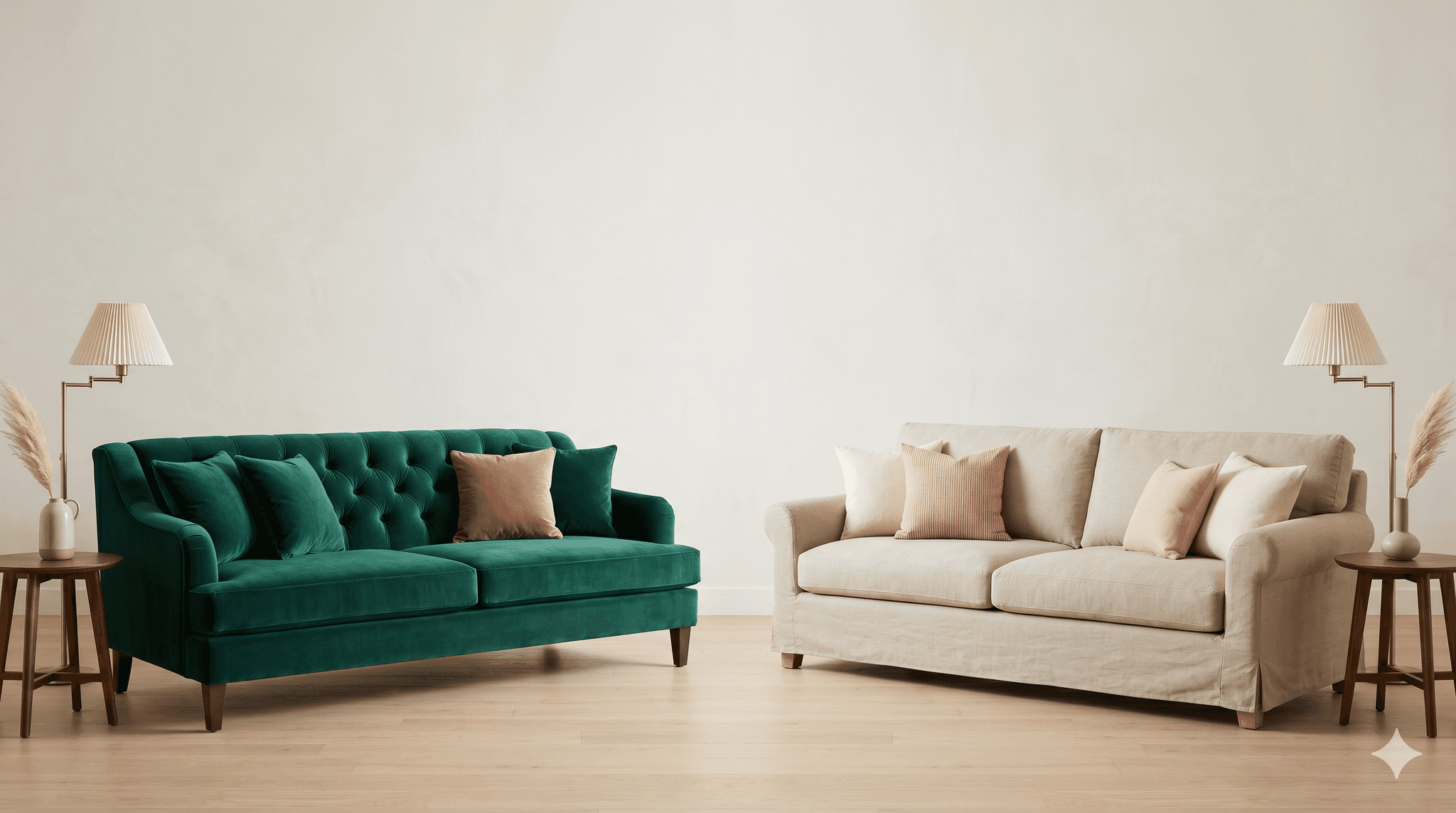
Velvet adds visual depth. The pile catches light differently from different angles, which is why a green velvet sofa can look forest green from one side of the room and almost black from another. This makes velvet powerful in a room that's otherwise minimal, it does the visual work.
Linen reads as casual, even in formal colors. It softens a room. It plays well with everything: leather, wood, brass, glass. It's the fabric that says "this room is comfortable" before you've sat down.
If your living room is otherwise minimal and you want one piece that holds the visual weight: velvet. If your living room is layered with texture and color and you want the sofa to be a foundation rather than a statement: linen.
Three velvet picks worth considering
1. The performance-velvet workhorse, around $1,800
The pick here is the Riley 84" Velvet Sofa in Hale Warm Gray from Article, 84 inches of performance velvet on a corner-blocked hardwood frame with reversible loose cushions and a fabric tested to 50,000 rubs. The sofa you buy when you want velvet but you have a real life happening on it. Best for: households with one or two adults plus occasional guests, no pets.
2. The dark green statement, around $1,600
The pick is the Landry 84.5" Velvet Sofa in Hale Fir Green from Article, a deep fir-green performance velvet on sleigh-style arms with the saturation that reads as "intentional" rather than "trending." The sofa that makes the room. Dark green velvet is the most forgiving statement color, it works against white walls, dark walls, wood paneling, and almost any rug. Best for: rooms that need a focal point, formal-leaning living rooms.
3. The compact velvet for small spaces, around $1,200
The pick is the Sven 72" Tufted Velvet Loveseat in Plush Pacific Green from Article, the small-apartment cousin of Article's flagship Sven sofa: a 72-inch tufted bench seat in performance velvet on a corner-blocked solid wood frame. For first apartments, studios, or rooms where a full-length sofa overwhelms. Best for: rentals, urban apartments under 700 sq ft.
Three linen picks worth considering
4. The slipcovered classic, around $1,600
The pick is the Landry 84.5" Slipcover Sofa in Fine White from Article, a coastal-leaning silhouette with sloping sleigh arms and a fully removable, machine-washable linen-blend slipcover. The sofa that lasts 20 years because you can wash the cover. Best for: families, anyone who values longevity over showroom perfection.
5. The Belgian-style flax linen, around $1,300
The pick is the Timber 90" Sofa in Rain Cloud Gray from Article, a low-slung 90-inch piece on honey-oak legs upholstered in a soft linen-viscose-polyester blend that reads as flax from across the room. The sofa Pinterest is built on. Slouchy, casual, ages beautifully. Best for: layered, lived-in homes; anyone who'd rather replace cushions than replace a sofa.
6. The performance linen for high-traffic, around $1,700
The pick is the Riley 84" Sofa in Napa White from Article, a 92 percent polyester, 8 percent linen blend in an oatmeal-white tone, stain-resistant, 50,000-rub tested. The compromise pick: linen aesthetic, performance durability. Best for: households that want the linen look but have real life happening on the sofa.
The wildcard pick
7. The leather alternative, around $1,700
The pick is the Sven 88" Tufted Leather Sofa in Charme Tan from Article, the Article best-seller in 100 percent top-grain Italian leather. If you've read this far and you're still torn between velvet and linen, consider leather. It outlasts both. It hides nothing but it doesn't need to, a worn leather sofa looks intentional in a way no other upholstery does. Higher upfront cost, lowest cost over a decade.
FAQ
Will velvet hold up with a cat? Performance velvet, yes, the polyester pile resists snags better than linen weave. Cotton velvet, no. Cats will pull the pile.
Does linen really wrinkle that much? Yes. If wrinkles bother you, don't buy linen. The wrinkles are the fabric. They're not going away no matter how often you steam.
Are slipcovers worth it? For families with kids or pets: yes, every time. For adults living alone: probably not, slipcovers can shift and never quite drape right again after a wash.
How can I tell if velvet is performance velvet or cotton velvet? Check the product spec sheet for fiber content. Performance velvet is typically 100% polyester. Cotton velvet says "cotton" or "cotton blend." If the listing doesn't specify, assume it's polyester (it almost always is at mid-range price points).
What about boucle? Boucle is having a moment but it pills aggressively, hides nothing, and ages worse than either velvet or linen. Skip it for a primary sofa unless you genuinely don't care about the 3-year mark.
Updated: April 2026. Hassan Muhsen is the founder of Furnish, the AI app that designs your actual room and lets you shop every piece in it. Join the waitlist at furnish.live.
Try Furnish on your room
Take a photo. Furnish does the rest.
Snap any room. Furnish redesigns it in your style and shows you every piece, real and shoppable.
Hassan Muhsen
Founder of Furnish. Writes about why he built it and what comes next.